
FREE REPORT
The Hidden Issue Behind the Origins Debate.
Most debates about origins focus on biology, fossils and geology. But the deeper issue lies elsewhere.
Our short report (The Origins Debate is Really About Infinity) explains why the origins question ultimately revolves around the concept of infinity — and why this changes how we should think about evolution, creation, and the foundations of reality.
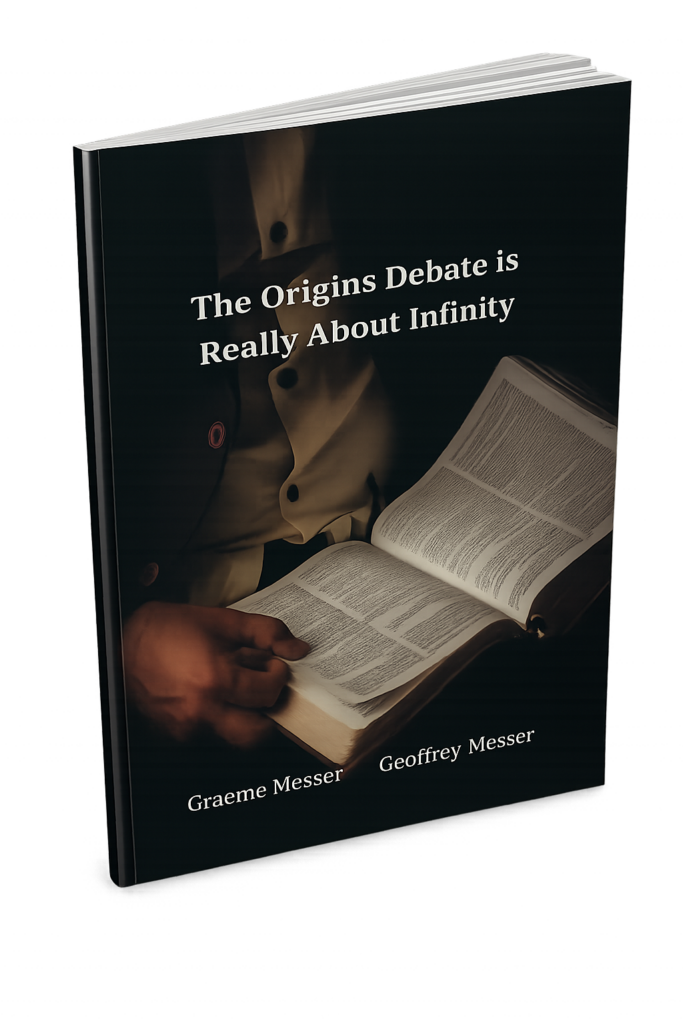
Free report • No spam • Unsubscribe anytime
For over a century the evolutionary story has shaped how people think about human origins. But what if the foundations of that story are weaker than most people realize?
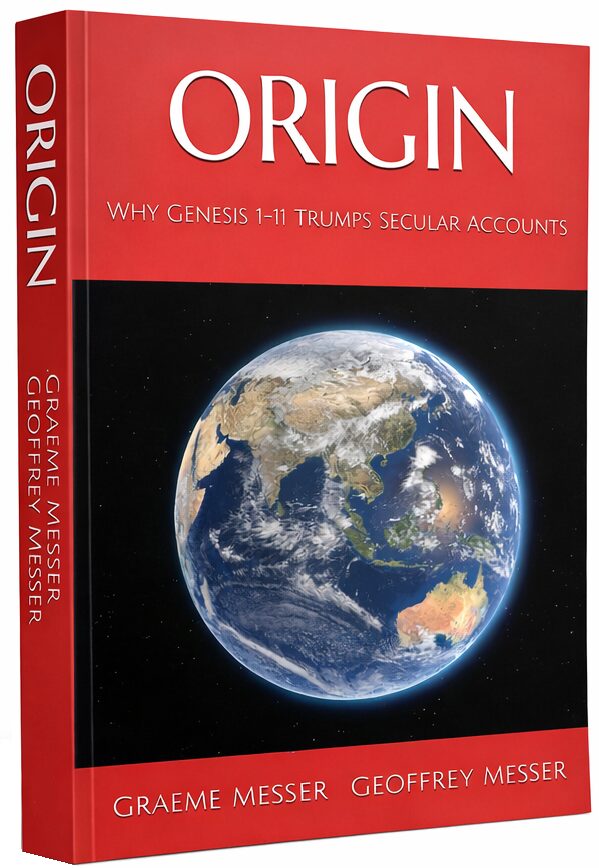
Origin: Why Genesis 1–11 Trumps Secular Accounts presents a powerful historical, philosophical and scientific challenge to modern evolutionary assumptions.
Join readers exploring the creation/evolution debate.
Why Origins Questions Matter
The origins question is not just a scientific question.
- If Genesis is wrong, the authority of Scripture is undermined
- The origins debate shapes how we understand science and faith
- Our view of human origins affects how we understand meaning, morality and civilization
- The issue ultimately turns on deeper philosophical assumptions
Origin: Why Genesis 1–11 Trumps Secular Accounts
The origins debate has long been an area of defensiveness for Christianity and a hot-button issue within the church. But up until now, there has been no high-level introduction to the creationist perspective which includes a rebuttal of secular accounts and a discussion of the effects of the evolutionary worldview on science and society. This book fills that gap—it uses an up-to-date, multidisciplinary approach to unravel these complex issues.
Graeme Messer, a trained engineer and published writer, and brother Geoffrey Messer, an anesthesiologist, have drawn on their scientific knowledge and research skills to bring readers this systematic study of the creation/evolution debate. Packed full of valuable information, Origin is an essential resource and reference for Christians who wish to understand this fascinating and important controversy. Whether scientifically minded or otherwise, readers will benefit from the historical, philosophical and theological arguments showing that Genesis 1–11 is plausible, essential, and defensible.

Inside the book you will discover:
- How Darwinian thinking reshaped modern culture
- The philosophical assumptions behind evolutionary thinking
- Scientific and logical challenges to secular origins accounts
- Why Genesis still offers a compelling explanation of our beginnings
What people are saying about Origin
“The Messer brothers are to be commended for placing this debate in the shifting cultural contexts of the 21st century.”
— Benno A. Zuiddam DTh PhD, North West University (South Africa), Free University Amsterdam (Netherlands)
“… the authors exceed anything else that has been published. If you are a Christian, an agnostic or an atheist, if you are a scientist or a layperson, this is the book for you. Want to go deeper? This book is heavily referenced, well-written and logically structured … a pleasure to read.”
— Dr Stephen Grocott BSc (Hons), PhD, Physical and Inorganic Chemistry
“A compelling account of the young-earth creationist view … compatible with modern science.”
—Kenneth Chan, Evangelist and Chaplain
An amazingly in-depth investigation into the debate surrounding Darwinism vs Creationism. This book delves into the history of how this issue arose, moves into arguments presented for Darwinism and presents counterpoints to these before looking at arguments in support of Creationism. This book is suitable for anyone looking to have a comprehensive understanding of the debate and evidence they can use to support a young-earth creationist position.
—Cole Thompson, Layperson
Contents
PART 1: ESSENTIAL BACKGROUND (pages 8–159)
- Two dying bulls
- Presuppositions
- Authority
- The personal aspect to worldviews
- The two Lazaruses
- Applying the Christian worldview
- Conclusion
- References
2 Sizing up the contenders
- The first criterion: The problem of existence
- The second criterion: The problem of information
- The third criterion: The problem of coherence
- The fourth criterion: The problem of consciousness
- The fifth criterion: Compatibility with science
- Conclusion
- References
3 The tool called science
- Categories of science
- Forensic case study: Flight MH370
- The importance of eyewitness evidence
- Conclusion
- References
4 The case of the missing philosophy
- A logical view of science: Popper
- A skeptical view of science: Feynman
- A historical view of science: Kuhn
- A social view of science: McElreath
- The missing philosophy
- Scientists behaving badly
- Conclusion
- References
5 The scientific rise and fall of the ancients
- A biblical scheme of history
- Babylonian developments
- Greek astronomy and cosmology
- The collapse of the Ptolemaic system: the Copernican revolution
- The Newtonian Era
- Analyzing the Copernican revolution
- The final break begins: the emergence of non-Euclidean geometry
- Enter infinity
- Maxwell’s marvel: electromagnetic radiation
- The fall of Grecian physics: Einstein’s relativity
- From Ptolemy, to Newton, to Einstein: analyzing the paradigm shifts in cosmology
- Pagan origins science
- The disproving of spontaneous generation
- Newton and Darwin: divergent responses
- The recrudescence of pagan origins
- References
6 The great reversal of science: from Christian to anti-Christian foundations
- The intellectual intrapment of the ancients
- Aristotle returns: priming Europe for empiricism
- The Black Death
- The Renaissance: onset of anti-Christian history
- Why did modern science begin in Europe?
- Presuppositional shift: Deism and Higher Criticism
- The emergence of anti-Christian origins science
- Christian pushback: the scriptural geologists
- References
7 Darwin’s Origin of Species and the emergence of the creationists
- Darwin’s theory
- The failed pushback of Philip Henry Gosse
- A shift in worldview
- The Darwinists organize: money, connections and power
- Darwin’s timing
- Eugenics: evolution with its sleeves rolled up
- Darwinism into schools
- A grand-scheme view
- Broken walls
- The creationists respond
- Creationist science
- References
8 Terms of the debate
- A crucial but subtle distinction
- Early days
- Evidence for evolution
- Microevolution
- Macroevolution
- An imprecise umbrella term
- The created kinds
- A different conception of kinds
- Secular humanist versus creationist views of biological history
- Death
- Motte and Bailey
- Conclusion
- References
PART 2: REBUTTAL OF SECULAR ORIGINS (pages 160–300)
9 Big Bang: the collapse of infinity
- The shifting fortunes of the eternal universe
- The underpinnings of Big Bang thought
- The development of the Big Bang account
- Other Big Bang models
- Borde-Guth-Vilenkin Theorum
- Shifting infinities
- Secular miracles
- Trouble in the ranks
- The collapse of the naturalistic origins account
- Secular humanist cosmology: where to from here?
- Conclusion
- References
10 Abiogenesis: a secular miracle
- From spontaneous generation to abiogenesis
- The mathematics of abiogenesis
- Exponential growth
- Tapping out the universe in six chessboards
- The probability of impossibility
- A putative candidate for abiogenesis
- Approaches to the abiogenesis problems
- Forcing their hands: the response of secularists
- Conclusion
- References
11 The fossil record: contradicting Darwin’s gradualism
- Pre-Darwinian investigations
- Change in the fossil record
- The “Cambrian explosion”
- Diarthrognathus broomi
- Summing up the fossil evidence
- Conclusion and outlook
- References
12 Mechanisms of variation: the consensus begins to fragment
- The slump
- From tea-clipper to maxi yacht: Neo-Darwinism
- The gene pool
- Natural selection
- Genetic drift: random “selection”
- Gene flow
- Summary thus far
- Speciation
- An explanation for novelty
- Point mutations
- Large-scale mutations
- The final Neo-Darwinian step
- Most mutations are harmful
- Mutational stepping-stones
- Extrapolation
- From maxi yacht to foiling monohull: without a rudder
- Picking up the pieces
- Headwinds affecting Neutral Theory
- Timing and textbooks
- The Third Way
- Conclusion
- References
13 The dead-end of common evolutionary descent
- Spetner: the information theorist
- Stephen C. Meyer
- Douglas Axe
- Hoyle’s doubt: a mathematical analysis of evolution
- “Evolution” in origins accounts: the real story
- Conclusion
- References
14 Darwinian aftermath: the rise of neopaganism
- Polyinfinitism
- A broad and diverse origins community
- The religious aspect of evolutionism
- Damaging social effects of evolutionism
- Government funded schooling
- Crushing dissent by the atheistic establishment
- Satanic discourse
- The rise of neopaganism
- The taunts of paganism
- The Reversi dictum
- Conclusion
- References
PART 3: A YOUNG EARTH CREATIONIST VIEW OF GENESIS 1–11 (pages 301–376)
15 Approaching Genesis
- Authorship
- Origins research from a biblical perspective
- Types of creation
- Supernatural formative processes
- References
16 Genesis 1–2: The creation week
- The First Day
- The Second Day
- The Third Day
- The Fourth Day
- The Fifth Day
- The Sixth Day
- The Seventh Day
- Two creation accounts?
- The historicity of Adam and Eve
- Marriage and blessing
- The God of Genesis
- References
17 The conundrum of the ages
- A biblical estimate of the age of the earth
- Scientific estimates of the age of the universe
- Light travel problem
- Relativistic effects: satellites and muons
- Biblical cosmologies
- Ages according to secular science
- A biblical analogy
- Assuming synchronized rates
- Non-synchronized rates
- Fitting the model
- Conclusion
- References
18 Genesis 3–6: The fall and judgement
- The fall of Man
- The trial
- The curse
- The family of Adam and Eve
- Violence and corrption
- God’s choice of Noah and the timing of the flood
- The ark
- Kinds, speciation and extinction
- Conclusion
- References
19 Genesis 7–11: Flood and confusion
- Biblical context
- The Flood (Genesis 7-8)
- Explaining the naturalistic aspects of the flood
- Evidence for the flood in the geological record
- How the Genesis flood explains the fossil record
- Life after the flood
- Rapid speciation after the flood
- Comparing the Genesis account with the Epic of Gilgamesh
- The Tower of Babel (Genesis 10:21-11:9)
- The effect of nations
- Genealogy of Shem
- Conclusion
- References
PART 4: OUTLOOK (pages 377–391)
20 The failure of the evolutionary worldview
- The pyrrhic victory of the X Club
- Tell-tale signs of rising paganism
- Changing standards in Hollywood
- Anno Pagano
- The rise of anti-science
- Neopaganism: a big tent
- The sixth criterion: the worldview values objective truth
- The immediate outlook for neopagan origins
- The outlook for young-earth creationism
- Conclusion
- References
APPENDICES (pages 392–449)
Appendix A: The problems of suffering and evil
- The problem of suffering
- The problem of evil
- Conclusion
Appendix B: Radiometric dating
- The RATE project
- Inferring from point-in-time observations
- How radiometric dating works
- RATE group findings
- Limitations and uses of Carbon-14 dating
- Unexpected results of Carbon-14 dating
- Calibration of Carbon-14 dating
- Comparison of various techniques
- Conclusion and areas for future research
Appendix C: Abiogenesis calculations
- Justification of probabilistic approach
- Probability of abiogenesis
Appendix D: The Intelligent Design Movement
- Background
- ID and creationism compared
- The view of the secular science establishment
- Conclusion
Appendix E: Catastrophic Plate Tectonics
- Runaway subduction
- Flood onset: “the fountains of the deep”
- Rising floodwaters
- Geological formations
- Sediments and their distribution
- Effect on the Earth’s magnetic field
- Ocean floor replacement and the end of the flood
- Climate change
- The problem of heat
Appendix F: Evidence for a young earth
References for Appendices
INDEX